
Cowhide vs. Goatskin Leather: What’s the Difference?
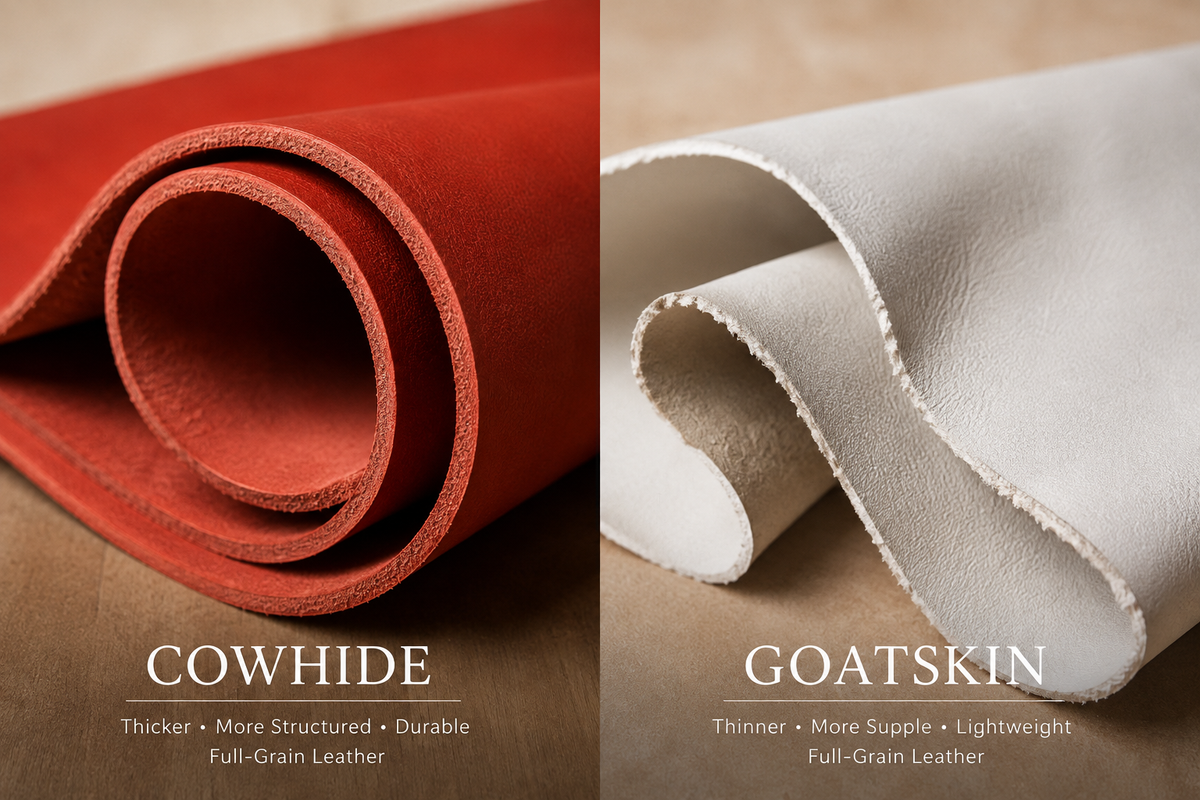
Not all leather behaves the same way.
Two hides can both be full-grain, both be high quality, and still feel completely different in the hand. The animal source, fiber structure, thickness, density, tanning, and finishing process all influence how the leather performs.
At Motif, we work primarily with two types of premium full-grain leather: cowhide and goatskin. We use them for different products because each material brings its own strengths.
The goal is not to decide which leather is “better.” It is to choose the leather that makes the most sense for the object being made.
Cowhide: substantial, structured, durable
Our cowhide is approximately 4 mm thick, giving it a substantial feel and strong structural presence.
That makes it particularly well suited for products that benefit from firmness and shape retention, including:
-
handbags
-
purses
-
backpacks
-
belts
Cowhide has a naturally robust character. At this thickness, it gives a bag more body and helps it hold its form rather than collapsing easily.
That structure is especially important in products where the silhouette is part of the design.
A handbag should not only carry your belongings. It should maintain the shape it was designed to have.
The same principle applies to belts. A belt needs sufficient thickness and strength to resist stretching and deformation during regular wear.
Goatskin: thinner, flexible, and surprisingly dense
Our goatskin is approximately 2 mm thick, roughly half the thickness of the cowhide we use.
At first glance, thinner leather may sound less durable.
That is not necessarily the case.
Goatskin can be particularly dense, which allows it to remain strong while offering more flexibility and less bulk. This combination makes it ideal for products that need to move, fold, or remain relatively lightweight.
At Motif, we use goatskin primarily for:
-
tote bags
-
wallets
A tote benefits from flexibility because the body of the bag needs to move naturally as it is filled and carried.
A wallet presents a different challenge. It needs durability, but excessive thickness quickly becomes impractical once several layers of leather, card pockets, and seams are combined.
Using a thinner, dense leather helps maintain strength without making the finished wallet unnecessarily bulky.
Thickness and strength are not the same thing
One of the most common misconceptions about leather is that thicker automatically means stronger.
Thickness certainly contributes to structure and resistance to deformation, but it is only part of the equation.
The density and organization of the leather fibers also matter.
A thinner piece of dense leather can perform exceptionally well, while a thicker but loosely structured leather may behave very differently.
That is why comparing leather only by millimeters does not tell the whole story.
For us, leather selection is about balancing several characteristics:
-
thickness
-
density
-
flexibility
-
stiffness
-
weight
-
intended use
The right combination depends on the product.
Why cowhide works well for structured bags
Imagine the body of a handbag.
It needs to support its own weight, hold hardware, withstand repeated opening and closing, and carry everything placed inside it.
If the leather is too soft or too thin, the bag may lose its intended silhouette.
Our thicker cowhide creates a stronger structural foundation.
It gives handbags and backpacks a substantial, tactile quality and allows embossed surfaces to retain a defined shape.
This does not mean the leather remains rigid forever. Full-grain leather gradually softens with handling and use.
The difference is that it begins with enough structure to age gracefully rather than simply collapsing.
Why goatskin works well for totes
A tote serves a different purpose.
It often needs to open widely, accommodate differently shaped objects, and flex comfortably against the body.
Too much stiffness can make a tote cumbersome.
The thinner goatskin we use provides greater flexibility while maintaining the density needed for everyday use.
The result is a leather that can move more naturally.
It can fold and flex without feeling overly heavy, which is particularly valuable in larger bags where the leather itself represents a significant portion of the finished weight.
Why goatskin works especially well for wallets
Wallet construction involves multiple layers.
A single exterior panel may be joined with interior panels, card pockets, dividers, and folded edges.
If every component were made from very thick leather, the finished wallet would quickly become bulky.
Goatskin allows us to build that layered structure while keeping the final object comfortable to carry.
Its density helps it remain durable even at a thinner profile.
This is a good example of why material selection should be based on the finished product rather than a simple assumption that more thickness is always preferable.
Do cowhide and goatskin feel different?
Yes.
Even when both are full-grain leather, their tactile character can differ noticeably.
Our cowhide generally feels:
-
heavier
-
thicker
-
more substantial
-
more structured
Our goatskin generally feels:
-
lighter
-
thinner
-
more flexible
-
compact and dense
The difference is easy to understand when the two materials are handled side by side.
Neither characteristic is inherently superior.
A structured handbag benefits from qualities that might be undesirable in a wallet, while the flexibility that makes goatskin excellent for a tote would produce a very different handbag silhouette.
How embossing affects both leathers
Both cowhide and goatskin can respond differently during embossing.
Embossing involves carefully controlled combinations of pressure, temperature, and airflow.
Those settings must be adjusted according to the leather being used.
A thicker cowhide does not behave exactly like a thinner goatskin under pressure. Even leather color can influence how the process needs to be managed.
The embossing process can increase density and stiffness, helping the leather retain the pattern and adding additional structure.
This is why embossing is not simply a decorative step.
It becomes part of how the material itself behaves.
Why leather color also matters
Leather is a natural material, and different colors do not always react identically during processing.
Dyes, finishes, thickness, and surface characteristics can all affect how a hide responds.
That means the same embossing settings cannot necessarily be used for every leather and every color.
The process must be adjusted to achieve a clean, consistent pattern while preserving the qualities of the leather.
For a collection with many colors, this becomes an important part of production.
How the two leathers age
Both full-grain cowhide and full-grain goatskin change with use.
They soften.
Areas that are frequently handled become smoother.
Color can become slightly richer or deeper.
Small marks accumulate and gradually become part of the surface character.
Because the two leathers begin with different structures, however, they may age differently.
A thick cowhide handbag may gradually become more supple while continuing to retain much of its shape.
A goatskin tote may become increasingly relaxed and fluid.
That evolution is part of why we enjoy working with natural leather.
The material does not remain static.
Which leather should you choose?
In most cases, you do not need to choose between cowhide and goatskin directly.
The product design has already made that decision.
We select the leather according to what the finished piece needs to do.
For a structured handbag, backpack, or belt, the substantial nature of cowhide makes sense.
For a flexible tote or carefully layered wallet, goatskin offers a better balance of strength and reduced bulk.
This approach allows each material to do what it does best.
The right leather for the right object
A good leather product begins long before the first seam is stitched.
It begins with material selection.
Leather should not be chosen simply because it is expensive, thick, or visually appealing. Its physical properties need to match the demands of the object.
That is why Motif uses both cowhide and goatskin rather than forcing one material to work for every product.
Our approximately 4 mm cowhide gives handbags, purses, backpacks, and belts the structure and substance they need.
Our approximately 2 mm goatskin provides totes and wallets with strength, flexibility, and a more practical thickness.
Different leather. Different character. Different purpose.
And that is exactly the point.