
How Embossed Leather Is Made
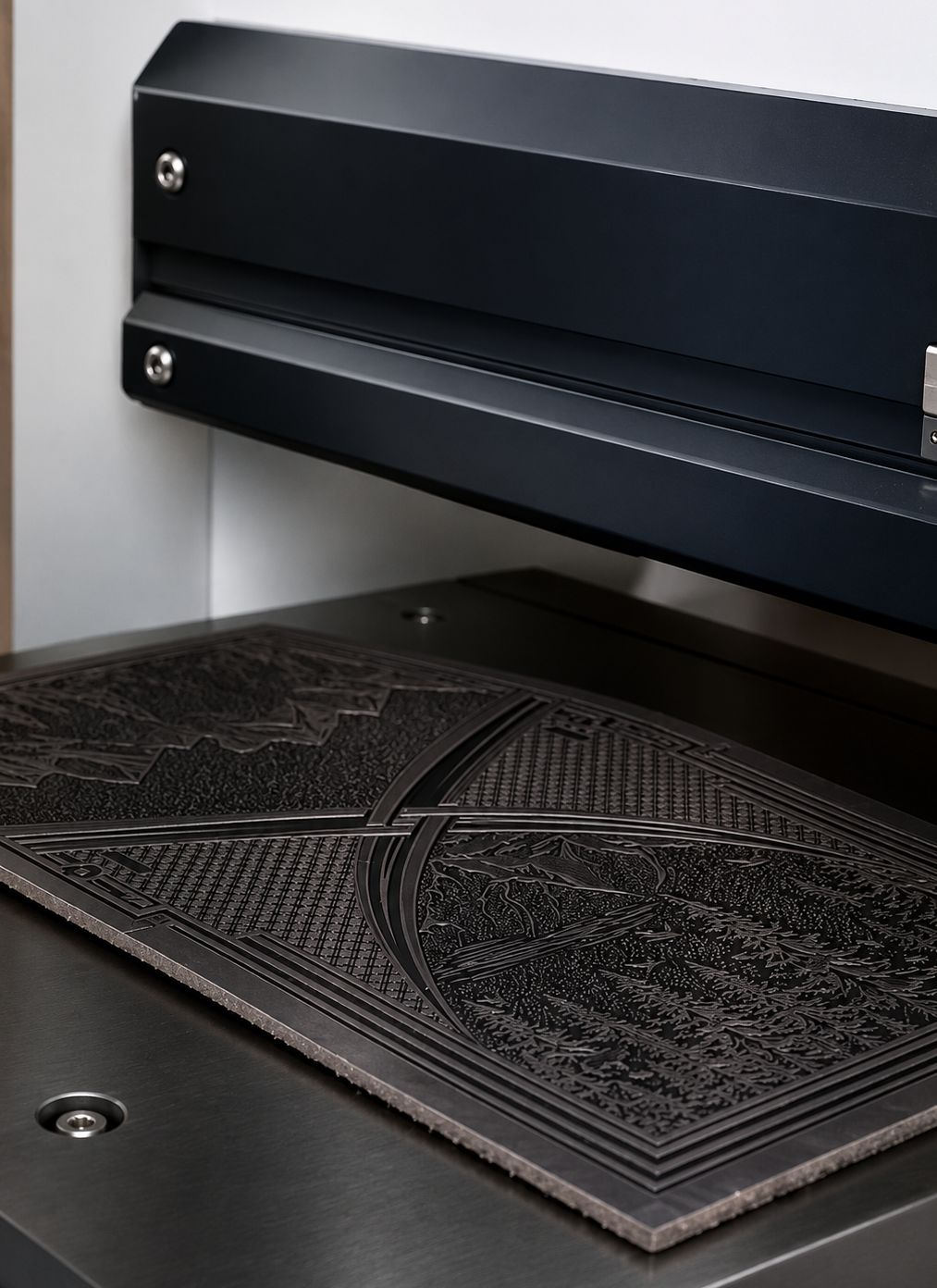
Embossed leather begins with a simple idea: take a natural material and give it a permanent surface pattern without losing the qualities that make leather valuable in the first place.
In practice, that process is far more technical than it looks.
A successful embossing result depends on the leather itself, the depth and complexity of the pattern, and a carefully controlled combination of pressure, temperature, and airflow. At Motif, those variables are adjusted according to the type and color of leather being used.
The goal is not just to make a pattern visible.
It is to make that pattern crisp, durable, and structurally compatible with the finished product.
It starts with the leather
Before embossing begins, the leather has already been selected for thickness, density, flexibility, and intended use.
Motif primarily works with two types of premium full-grain leather:
-
approximately 4 mm cowhide for handbags, purses, backpacks, and belts
-
approximately 2 mm goatskin for tote bags and wallets
These two leathers do not react identically during embossing.
A thicker cowhide requires a different approach than a thinner goatskin because the material responds differently to heat and pressure.
That means the embossing process cannot simply use one universal setting.
The leather determines the process.
The pattern is transferred under pressure
Embossing uses a patterned surface or die to press a design into the leather.
The leather is positioned carefully, and pressure is applied so the pattern is transferred into the surface.
The amount of pressure matters.
Too little pressure and the impression may be shallow or inconsistent.
Too much pressure can distort the leather or push the pattern beyond the depth needed for a clean result.
The objective is to create definition without damaging the material.
Temperature helps shape the leather
Pressure alone is only part of the process.
Temperature influences how readily the leather accepts and retains the embossed pattern.
When controlled correctly, heat helps the leather fibers respond to the die and allows fine details to become more clearly defined.
But leather is a natural material, not a uniform synthetic sheet.
Different hides, colors, thicknesses, and finishes can respond differently to temperature.
For that reason, heat must be carefully balanced with pressure.
The correct combination gives the pattern depth while preserving the character of the leather.
Airflow is part of the equation
Airflow is less obvious, but it is also an important part of the process.
Leather reacts to changes in heat and moisture.
Controlled airflow helps manage the environment around the leather during embossing and influences how the material stabilizes as the pattern is formed.
Together, pressure, temperature, and airflow create the conditions that allow the pattern to become permanent and consistent.
Changing one variable can affect the others.
That is why embossing is not simply a matter of pressing a design into a hide.
It is a controlled production process.
Leather color changes the settings
One detail that is easy to overlook is color.
Different leather colors can respond differently during embossing because of variations in dyes, finishes, and surface treatment.
A setting that produces excellent detail in one color may need adjustment for another.
This becomes especially important when working with a broad color collection.
At Motif, we work with 21 colors, so the embossing process must be adaptable.
The goal is consistency across the collection without forcing every leather to behave the same way.
The pattern increases density
Embossing changes more than appearance.
As the leather is compressed, the material becomes denser in the embossed areas.
This can increase:
-
stiffness
-
structural definition
-
resistance to deformation
-
overall firmness
That additional density is one reason embossed leather can feel noticeably different from plain leather of the same original thickness.
The process gives the material both visual and physical structure.
Why embossed leather can feel stronger
When pressure compresses the leather fibers, the finished material can become firmer and more resistant to bending.
That does not mean embossing transforms weak leather into strong leather.
The quality of the original hide still matters.
But when high-quality full-grain leather is embossed correctly, the process can reinforce its structural character.
This is especially useful in products where shape retention is important.
A structured handbag, for example, benefits from leather that can hold its form while still remaining flexible enough for everyday use.
Deep patterns require more control
A simple texture and a deeply detailed pattern are not the same manufacturing challenge.
Intricate embossing contains many small lines, recesses, borders, and transitions.
Each part of the design needs enough pressure to become visible without flattening adjacent details.
The deeper and more complex the pattern, the more precisely the process needs to be controlled.
That precision is what allows fine details to remain readable across a large leather panel.
Thickness changes the result
A 4 mm cowhide panel does not behave like a 2 mm goatskin panel.
The thicker material has more body and can support deeper structural definition.
The thinner material may respond more quickly and requires more careful control to preserve flexibility.
This is why embossing settings are adjusted according to the leather rather than according to the pattern alone.
The same design can require different processing depending on the material beneath it.
Why the leather is not simply printed
Embossing is fundamentally different from applying a printed surface design.
A printed pattern sits on the leather.
An embossed pattern becomes part of the physical surface.
You can see it in the highlights and shadows.
You can feel it with your fingers.
The design changes how light moves across the leather and how the material behaves in the hand.
That physical depth is what gives embossed leather its distinctive character.
What happens after embossing
Once the pattern has been formed, the leather needs to stabilize.
The surface is inspected for:
-
even depth
-
clean edges
-
consistent pattern definition
-
unwanted distortion
-
surface damage
Only leather that meets the required standard moves on to cutting and assembly.
This inspection matters because embossing happens before the leather becomes a finished bag, wallet, belt, or backpack.
Any inconsistency at this stage will become much more noticeable once the product is assembled.
Embossing affects the final product
The embossed surface becomes part of the design language of the finished piece.
It influences:
-
how the leather reflects light
-
how structured the product feels
-
how the surface wears over time
-
how color appears across raised and recessed areas
-
how the object feels when handled
This is why embossing should not be treated as a decorative afterthought.
It is part of the material engineering of the product.
Why each batch requires attention
Leather is a natural material.
Even carefully selected hides can vary slightly in density, moisture content, grain, and surface response.
Because of that, embossing cannot be treated as a completely automatic process.
Settings may need adjustment from one leather type or color to another.
Experience matters.
The process depends on understanding how the material behaves and recognizing when the result is correct.
From plain hide to finished pattern
Before embossing, the leather is a flat natural surface.
After embossing, it has depth, structure, and a completely different visual identity.
But the transformation only works when the process respects the material.
Pressure must be strong enough.
Temperature must be controlled.
Airflow must be appropriate.
Leather type and color must be taken into account.
When those elements work together, the result is a pattern that is not simply placed on the leather.
It becomes part of the leather itself.
That is what makes embossed leather so distinctive — and why making it well requires far more than a press and a pattern.