
The Art of Leather Embossing: From Plain Hide to Pattern
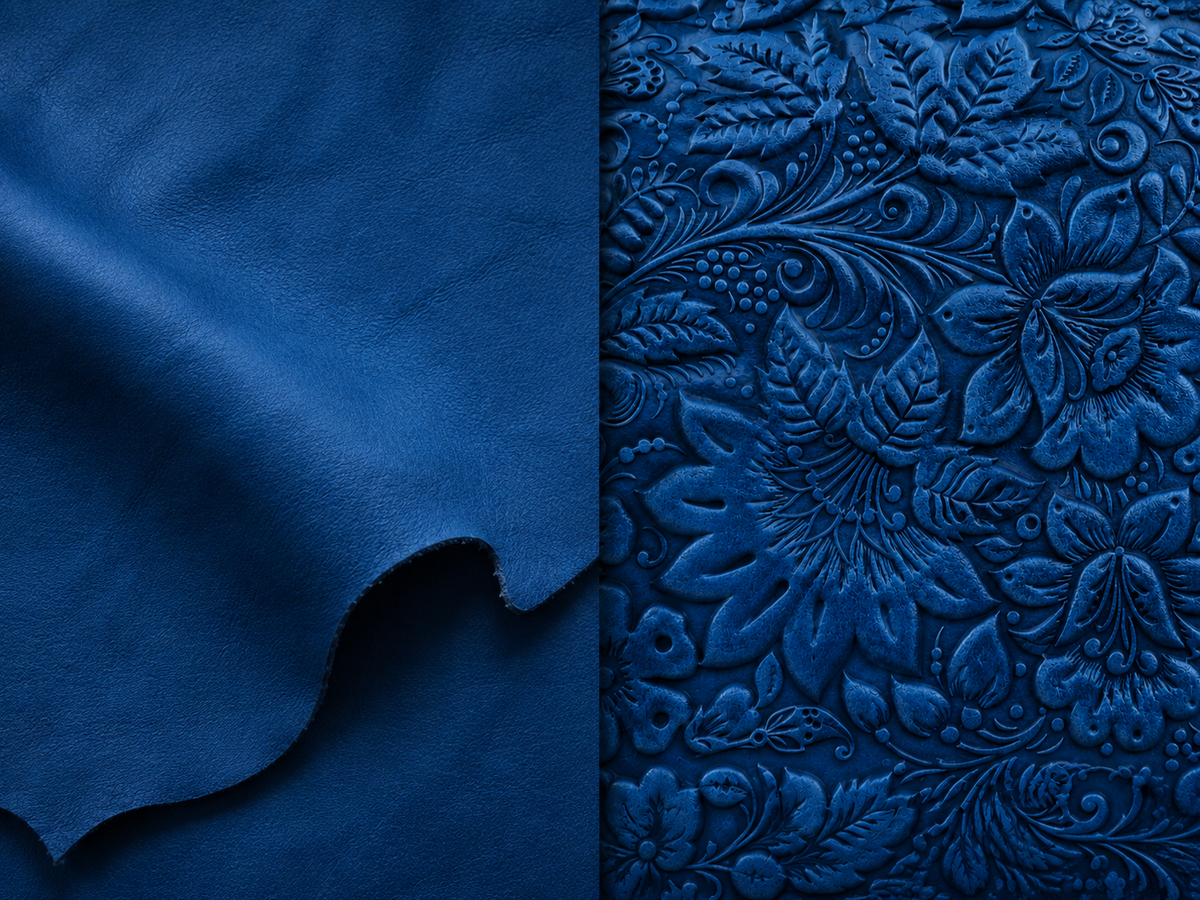
A plain leather hide can be beautiful on its own.
Its grain, color, density, and natural variation already give it character. Embossing takes that surface and transforms it into something more dimensional — a pattern you can see, feel, and recognize immediately.
At Motif, embossing is one of the defining parts of the design language. It turns flat leather into a textured surface with depth, shadow, and structure.
But the transformation is not simply decorative.
It begins with the material, depends on carefully controlled production, and ends with a leather panel that behaves differently from the hide it started as.
The process begins with full-grain leather
Before a pattern is ever applied, the leather itself has to be suitable for the finished product.
Motif primarily works with two full-grain leathers:
-
approximately 4 mm cowhide for handbags, purses, backpacks, and belts
-
approximately 2 mm goatskin for tote bags and wallets
Each leather has a different thickness, density, and level of flexibility.
Those characteristics influence how deeply a pattern can be formed and how the material responds during embossing.
The same design cannot simply be pressed into every hide using identical settings.
The leather determines the approach.
From a flat surface to a dimensional pattern
Embossing works by pressing a patterned surface into the leather.
As pressure is applied, parts of the leather are pushed inward while others remain raised.
That creates the visual depth of the design.
Lines become grooves.
Borders become defined.
Flowers, leaves, geometric motifs, landscapes, or other elements emerge from what was previously a flat surface.
The pattern is not painted onto the leather.
It is physically formed into it.
That distinction is what gives embossed leather its tactile character.
Why pressure matters
Pressure determines how clearly the design is transferred.
Too little pressure and the pattern may look weak or incomplete.
Fine details can disappear.
Large areas may emboss unevenly.
Too much pressure creates a different problem.
The leather can become overly compressed or distorted, especially in areas where the pattern contains very fine detail.
The goal is not simply to press harder.
It is to use enough pressure to create definition while maintaining the integrity of the material.
Temperature helps create definition
Heat helps the leather respond to the embossing process.
Under controlled temperature, the material becomes more receptive to the patterned surface and can retain fine details more effectively.
This becomes especially important with intricate designs.
Small borders, detailed foliage, repeating textures, and recessed patterns all need enough definition to remain visually clear.
Temperature helps that structure form.
But it must be controlled carefully.
Leather is sensitive to excessive heat.
The objective is precision, not maximum intensity.
Airflow completes the environment
Airflow plays a quieter but important role.
Leather reacts to changes in heat and moisture.
Controlled airflow helps manage the conditions around the material while the pattern is formed and stabilized.
Pressure, temperature, and airflow therefore work together.
The correct balance produces a clean, consistent impression.
Changing one variable can affect the others.
That is why embossing requires adjustment rather than a single fixed setting.
Color changes the way leather responds
Leather color is another variable.
Different dyes and finishes can influence how the surface reacts to pressure and heat.
A deep dark color may behave differently from a pale neutral.
Even when the leather type and thickness are the same, production settings may need to change.
Motif works with 21 colors, which means consistency requires flexibility in the embossing process.
The objective is to preserve the same level of pattern definition across the collection while respecting the behavior of each leather.
Intricate patterns are more demanding
Not every embossed design requires the same level of control.
A simple repeating texture is relatively forgiving.
A highly detailed design is not.
Intricate patterns may contain:
-
narrow borders
-
tiny decorative lines
-
large central motifs
-
deeply recessed areas
-
fine background texture
-
sharp transitions between raised and lowered surfaces
Every part of the pattern needs to remain readable.
If pressure is uneven, some details may disappear while others become too pronounced.
If temperature is incorrect, the surface may not hold the pattern consistently.
Complex embossing demands precision.
The leather changes physically
One of the most interesting parts of embossing is that the leather does not leave the process exactly as it entered.
Pressure compresses the fibers.
This increases density in the embossed areas and can make the leather feel firmer and more structured.
The pattern therefore changes both appearance and behavior.
A plain leather panel and an embossed panel made from the same hide can feel noticeably different.
The embossed piece may hold its shape more strongly and resist deformation more effectively.
The design becomes part of the material structure.
Light makes the pattern come alive
Embossed leather changes dramatically depending on how it is viewed.
Raised surfaces catch light.
Recessed areas fall into shadow.
The same pattern can appear subtle in diffuse light and much more dramatic in directional light.
Color also interacts with the relief.
A deep blue, rich red, cognac, olive, or neutral tone can reveal different parts of the same design.
That is one reason embossed leather has such visual depth.
The surface is constantly changing as the object moves.
Touch is part of the experience
Embossing is not only visual.
The texture can be felt immediately.
A hand moving across the surface encounters raised borders, recessed motifs, smooth sections, and detailed texture.
That tactile quality is difficult to reproduce with printed decoration.
The pattern is not an image of texture.
It is actual texture.
That physical interaction is an important part of the character of an embossed leather piece.
Pattern placement matters
Once the leather has been embossed, the next challenge is cutting.
Patterned leather cannot always be treated like a completely uniform sheet.
The placement of a handbag panel, wallet front, flap, or pocket affects which part of the design appears on the finished product.
A large central motif may need to be positioned intentionally.
Borders may need to align with edges.
Important details should not disappear into seams or hardware.
That makes pattern placement part of the construction process.
The leather pattern and the product design have to work together.
The design must survive assembly
A beautifully embossed panel is only useful if it continues to look right after the object is built.
The leather may later be:
-
cut
-
folded
-
stitched
-
joined to other panels
-
fitted around hardware
-
shaped into corners and gussets
The pattern has to remain clear through all of those steps.
This is another reason material thickness and embossing depth matter.
The leather must be structured enough to hold the design while still being workable.
Embossing and color work together
Pattern and color cannot really be separated.
The same embossed design can feel completely different depending on the leather color.
A muted neutral can make the pattern subtle and architectural.
A saturated color can emphasize every raised line and recessed detail.
Two-tone products create another layer of contrast by allowing different panels or structural areas to interact visually.
Motif handbags, purses, backpacks, and totes can be made in solid or two-tone combinations, giving the same embossed surface very different personalities.
From material to identity
Before embossing, a hide is simply leather.
After embossing, it begins to carry a recognizable visual identity.
The surface becomes more than a material choice.
It becomes part of the design itself.
That is especially important for Motif because the embossed patterns are not meant to disappear into the background.
They are meant to be noticed.
The pattern gives each piece presence before you even look at the construction.
The finished surface still needs to age naturally
Embossed leather is structured, but it is still leather.
It will soften.
It will be handled.
It will develop subtle changes in tone and sheen.
Raised areas may become smoother with use, while recessed areas can retain more of their original depth.
That gradual change adds another dimension to the pattern.
The design remains, but the surface becomes increasingly individual.
From plain hide to something unmistakable
Embossing begins with a flat sheet of full-grain leather.
Then pressure gives it depth.
Temperature helps define the detail.
Airflow helps stabilize the process.
Leather type, thickness, and color determine how those variables need to be adjusted.
The finished result is stronger, denser, more structured, and visually transformed.
That is the art of leather embossing.
Not simply adding decoration to leather, but changing the surface so completely that pattern and material become one.