
What Is Full-Grain Leather? A Guide to the Highest Grade of Leather
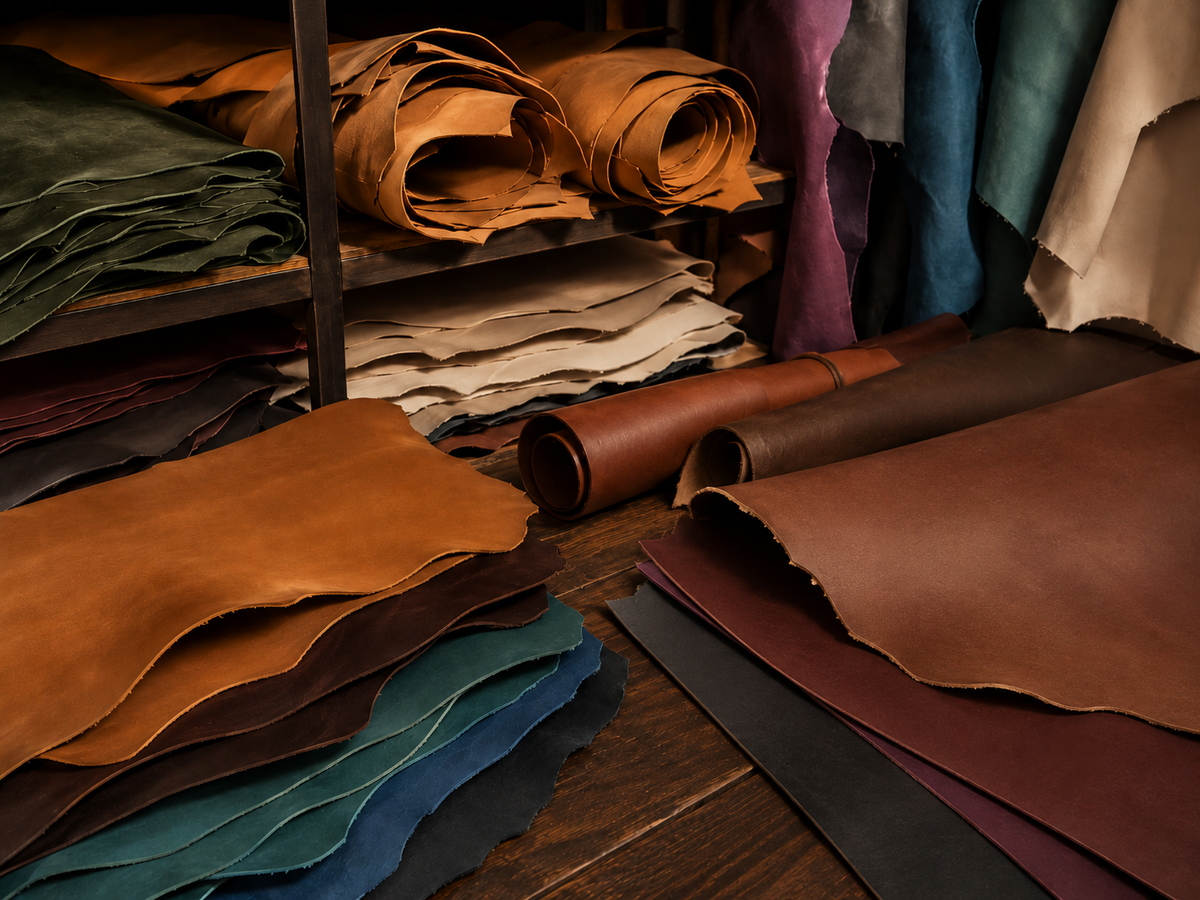
Leather is often described with words like genuine, premium, top-grain, and full-grain. Those terms can sound interchangeable, but they are not. The way a hide is processed has a major effect on how the finished leather looks, feels, ages, and performs over time.
For Motif, full-grain leather is the foundation of the collection because it preserves the natural strength and character of the hide. Instead of sanding away the outer surface to create a perfectly uniform appearance, full-grain leather retains the grain layer where much of the hide’s natural structure remains intact.
That difference matters.
What does “full-grain leather” actually mean?
A leather hide is made up of several layers. The outermost portion contains the natural grain of the animal’s skin. In full-grain leather, that surface is preserved rather than aggressively sanded or corrected.
As a result, the finished leather may retain subtle variations in texture, grain, and tone. These are not necessarily imperfections. They are evidence that the natural surface of the hide is still present.
Full-grain leather can therefore look less mechanically uniform than heavily corrected leather, but that natural variation is also a large part of its appeal.
No two pieces age in exactly the same way.
Why is full-grain leather considered the highest grade?
The grain layer is one of the strongest portions of the hide. When it remains intact, the leather retains more of its natural fiber structure.
That gives full-grain leather several important characteristics:
-
excellent durability
-
strong resistance to everyday wear
-
natural surface texture
-
the ability to soften gradually without losing its character
-
the ability to develop a patina over time
Rather than simply wearing out, well-made full-grain leather often changes with use.
Edges soften. The surface becomes more supple. Areas that are frequently handled can become smoother or slightly deeper in tone. Small marks begin to blend into the history of the piece.
This evolution is one of the reasons full-grain leather is so closely associated with products designed to last.
Full-grain leather vs. top-grain leather
The names are similar, but there is an important distinction.
Full-grain leather retains the natural grain surface of the hide.
Top-grain leather is also taken from the upper portion of the hide, but its surface may be sanded, buffed, or corrected to remove irregularities before finishing.
That additional processing can create a smoother and more uniform appearance. For some products, that consistency is desirable.
Full-grain leather takes a different approach. Instead of trying to erase every natural variation, it allows the material itself to remain visible.
The result is leather with more individual character and a surface that can continue changing throughout its life.
What about “genuine leather”?
“Genuine leather” simply means that a product contains real leather. It does not automatically indicate the highest quality.
The term can be applied to many different types and grades of leather, including materials made from lower layers of the hide.
That is why the phrase alone tells you relatively little about how the leather was processed, how strong it is, or how it will age.
When evaluating a leather product, understanding the specific type of leather is far more useful than relying on the word genuine.
Why does full-grain leather develop a patina?
Patina is the gradual change that happens as leather interacts with its environment.
Your hands transfer small amounts of natural oils to the surface. Sunlight can subtly affect color. The leather bends and flexes as it is carried. Everyday handling gradually changes the texture.
Over time, these influences can create richer tones, softened edges, smoother high-contact areas, and subtle differences in sheen.
That process is particularly visible in full-grain leather because the natural surface has been preserved.
A patina should not be confused with neglect or damage. When leather is properly cared for, patina is simply part of the way the material matures.
A bag that has been carried for years may no longer look identical to the day it was purchased — and that is precisely the point.
Why Motif uses different full-grain leathers
Not every product benefits from exactly the same leather.
Motif works primarily with two types of premium full-grain leather, selected according to the structure and function of the finished piece.
Our cowhide is approximately 4 mm thick and is used for products such as handbags, purses, backpacks, and belts. Its substantial thickness gives these pieces structure and durability.
Our goatskin is approximately 2 mm thick and is used for products such as tote bags and wallets. Although thinner, goatskin can be particularly dense, allowing it to remain durable while providing greater flexibility.
The goal is not simply to use the thickest possible leather. It is to match the material to the object.
A belt, wallet, structured handbag, and soft tote all experience different stresses and need different characteristics.
Does thicker leather always mean better leather?
No.
Thickness is only one characteristic of leather.
A very thick hide can still be poorly processed, while a thinner high-quality leather can be exceptionally strong. Fiber density, tanning, finishing, hide selection, and construction all influence how a finished product performs.
For that reason, comparing leather only by thickness can be misleading.
The better question is whether the leather has the appropriate combination of density, flexibility, structure, and thickness for the product being made.
How embossing changes full-grain leather
Many Motif pieces feature deeply embossed leather.
Embossing is not simply a printed decoration applied to the surface. The pattern is formed through a controlled process involving pressure, temperature, and airflow.
Those parameters must be adjusted according to the type and color of leather being used.
The process can also change the physical character of the material. Proper embossing increases density and can make the leather stronger, firmer, and more structured.
This is especially important for detailed patterns, where the impression needs to remain crisp while the leather continues to function as a durable material.
It is one of the places where design and material engineering meet.
Is full-grain leather supposed to look perfectly uniform?
Usually not.
Natural grain can include small variations in texture and tone. Even when hides are carefully selected and finished, leather is still an organic material.
Color can also respond differently across the grain, especially when the leather is embossed.
That natural variation is part of what distinguishes leather from synthetic materials designed to reproduce exactly the same surface repeatedly.
For someone expecting absolute visual uniformity, full-grain leather may initially seem less perfect.
For someone who values material character, those differences are part of what makes it beautiful.
How should full-grain leather be cared for?
Full-grain leather generally benefits from simple care rather than aggressive cleaning.
Remove dust with a soft cloth or soft brush. When necessary, gently wipe the surface with a slightly damp cloth and allow it to dry naturally.
Avoid household cleaners, detergents, harsh soaps, washing machines, and artificial heat. These can remove natural oils from the leather or damage its surface.
When storing a leather piece, keep it in a breathable dust bag away from prolonged direct sunlight and excessive heat. Avoid sealing leather in plastic for long periods.
If the leather becomes wet, allow it to air-dry naturally at room temperature.
The objective is not to keep leather frozen in its original condition. It is to allow it to age well.
Is full-grain leather worth it?
For products intended to be disposable or perfectly unchanged throughout their lives, full-grain leather may not be necessary.
But for objects meant to be carried, touched, used, and kept for years, it has a unique advantage.
Its strength gives it longevity. Its natural grain gives it individuality. And its ability to develop a patina means that the material can become more personal rather than simply older.
That is ultimately why we choose it.
At Motif, we believe a well-made leather object should not reach its most interesting moment on the day it leaves the workshop.
It should continue becoming yours.