
Why Leather Thickness Matters in Bags, Wallets and Belts
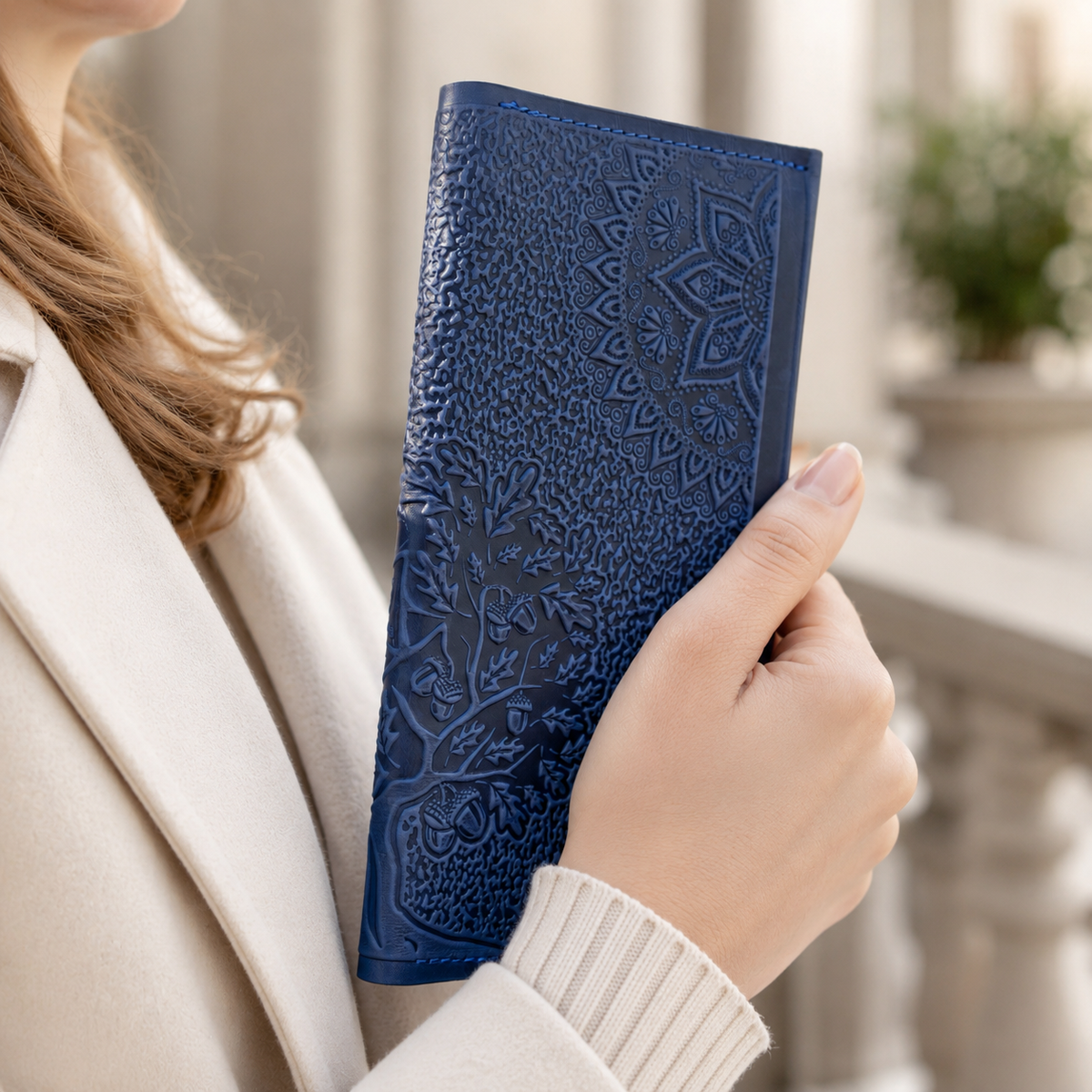
Leather thickness changes far more than how substantial a product feels.
It affects structure, flexibility, weight, durability, edge definition, stitching, and even how an item ages over time. A leather that works beautifully for a belt may be completely impractical for a wallet, while a leather that makes an excellent tote may be too soft for a structured handbag.
At Motif, leather thickness is chosen according to the job the finished piece needs to perform.
What does leather thickness actually affect?
When leather becomes thicker, several things usually change with it.
Thicker leather tends to provide more:
-
structure
-
resistance to stretching
-
edge definition
-
shape retention
-
physical substance
Thinner leather tends to provide more:
-
flexibility
-
lighter weight
-
easier folding
-
reduced bulk
-
movement
Neither is automatically better.
The correct thickness depends on the product.
Why handbags need structure
A handbag has to support much more than its own weight.
It carries hardware, handles, straps, lining or interior components, and everything placed inside it. It also needs enough structural stability to maintain its intended silhouette.
If the leather is too thin or too soft, a structured handbag can quickly lose its shape.
For this reason, Motif uses cowhide approximately 4 mm thick for many of our handbags and purses.
That substantial thickness gives the leather enough body to hold its form while still allowing it to soften naturally with use.
The result is a bag that feels solid without being rigid.
Why backpacks benefit from thicker leather
Backpacks experience constant movement and stress.
The body of the bag flexes as it is carried. Shoulder straps pull against attachment points. The base supports weight. Openings and closures are used repeatedly.
A thicker leather provides additional support in these high-stress areas.
It also helps the backpack maintain its structure when it is partially empty, rather than collapsing completely.
Over time, full-grain leather will still become more supple, but starting with sufficient thickness gives the material a stronger foundation.
Why belts need substantial leather
Belts are one of the clearest examples of why thickness matters.
A belt is repeatedly placed under tension.
Every time it is worn, the leather is pulled through the buckle, bent around the body, and stressed around the adjustment holes.
If the leather is too thin, it can stretch excessively or lose its shape.
That is why Motif uses substantial cowhide for belts.
The thickness contributes to strength, but it also gives the belt the visual weight and firmness expected from a well-made leather belt.
Why wallets need something different
Wallets present almost the opposite problem.
A wallet may contain many individual leather components:
-
exterior panels
-
interior panels
-
card pockets
-
dividers
-
folded edges
Each layer adds thickness.
If every layer were made from the same heavy leather used for a belt, the finished wallet could become uncomfortably bulky before a single card was placed inside.
That is why thinner leather makes more sense.
Motif uses goatskin approximately 2 mm thick for wallets.
Its thinner profile allows multiple layers to be assembled while keeping the finished piece practical.
Thin does not mean weak
Thickness and strength are related, but they are not the same thing.
Leather strength also depends on fiber density, hide quality, tanning, finishing, and construction.
Goatskin can be particularly dense.
That means a thinner goatskin can still provide excellent durability while remaining more flexible and less bulky than a much thicker hide.
This balance is exactly what makes it useful for wallets and other products where several layers of leather must work together.
Why tote bags benefit from thinner leather
A tote should behave differently from a structured handbag.
Rather than maintaining a rigid silhouette, it often needs to open widely, flex around its contents, and sit comfortably against the body.
Using very thick leather would add unnecessary weight and stiffness.
Thinner goatskin allows the bag to move more naturally.
It gives the tote flexibility while still retaining the strength expected from full-grain leather.
This becomes especially important as the size of the bag increases. A large bag made entirely from heavy leather can become surprisingly heavy before anything is placed inside it.
Thickness also affects weight
Leather is a dense natural material.
Increasing thickness increases the amount of material in the finished product, and therefore its weight.
On a belt, that additional weight is usually insignificant.
On a large tote or backpack, it can become much more noticeable.
Good product design therefore requires a balance.
The leather needs enough substance to perform properly without making the finished object unnecessarily heavy.
Thickness changes how leather folds
A thin leather can make a tight fold relatively easily.
A thick leather naturally creates a broader curve.
This affects the construction of:
-
pockets
-
flaps
-
gussets
-
handles
-
folded edges
-
interior compartments
A wallet, for example, requires precise folds and multiple closely spaced layers.
A structured handbag may benefit from broader, more substantial curves.
Leather thickness therefore influences not only durability, but the geometry of the design itself.
Thickness matters at the edges
One of the easiest places to see the difference between leathers is along a cut edge.
A thick cowhide edge looks substantial and architectural.
A thinner goatskin edge appears finer and more delicate.
This has a major effect on the visual character of the finished product.
On a belt or structured bag, a strong visible edge contributes to the sense of solidity.
On a wallet, excessive edge thickness would quickly make the construction feel heavy and cumbersome.
How thickness affects embossing
Leather thickness also changes the way material responds during embossing.
A substantial hide can accept deep pressure while maintaining enough body to support the resulting pattern.
Thinner leather behaves differently and requires different handling.
Pressure, temperature, and airflow must therefore be adjusted according to the type and thickness of leather being embossed.
The goal is to achieve a well-defined pattern without compromising the leather itself.
This is another reason leather selection and production technique cannot be separated.
Does thicker leather last longer?
Not necessarily.
A thicker leather can provide excellent resistance to stretching and deformation, but longevity depends on more than thickness alone.
A well-made product also depends on:
-
leather quality
-
fiber density
-
tanning
-
stitching
-
construction
-
hardware
-
care
A poorly made object will not become excellent simply because the leather is thick.
Likewise, a thinner high-quality leather used appropriately can last for many years.
The important question is whether the material is suitable for its purpose.
How leather thickness changes with age
Full-grain leather does not remain exactly as it was on the day it was made.
With use, it bends, flexes, softens, and develops a patina.
Thicker leather often becomes noticeably more supple while continuing to retain much of its original structure.
Thinner leather may become even softer and more fluid.
This aging process is part of the character of the material.
A good design anticipates how the leather will behave not only when the product is new, but years later.
Why one leather cannot do everything
It would certainly be simpler to make every product from the same leather.
But simplicity in production does not necessarily produce the best object.
A wallet and a belt have completely different requirements.
So do a tote and a structured handbag.
At Motif, our thicker cowhide is used where structure and resistance to deformation matter most, including handbags, purses, backpacks, and belts.
Our thinner goatskin is used where flexibility and reduced bulk are more important, particularly totes and wallets.
The right thickness is part of the design
Leather thickness is not an afterthought.
It is one of the first design decisions.
It influences how a product feels in the hand, how it carries weight, how it folds, how it holds its shape, and how it changes with use.
That is why the thickest leather is not automatically the best leather.
The best leather is the one whose thickness, density, and character match the object it is becoming.
A belt should feel like a belt.
A wallet should still fit comfortably in a pocket.
A tote should move.
A handbag should hold its shape.
Choosing the right leather thickness is what allows each of those objects to do exactly that.